.png)
The Most Common Hammer Mill Parts That Wear Out First

Updated: Jul 15

A hammer mill is a bit of a strange machine when you think about it.
The entire grinding process depends on controlled destruction. Material enters the grinding chamber, gets struck repeatedly at high speed, collides with other particles, impacts internal surfaces, and eventually exits once it's small enough to pass through the screen.
None of that happens gently.
Every ton of material that moves through the mill leaves behind a little evidence of its journey. Sometimes it's barely noticeable. Sometimes it's a worn hammer edge, an enlarged screen opening, or a liner that's become thinner than anyone realized. Eventually, every hammer mill reaches the point where performance starts slipping and replacement parts become part of the conversation.
The interesting thing is that not all hammer mill parts wear at the same rate. Some components can remain in service for years with minimal attention. Others spend every day absorbing impacts, abrasion, vibration, and constant material contact. Those are the parts that tend to wear out first.
Understanding where wear typically occurs can make maintenance planning much easier. It can also help prevent the kind of downtime that usually shows up at the worst possible moment… right when production is critical and nobody wants to shut the mill down.
Why Some Hammer Mill Parts Wear Faster Than Others
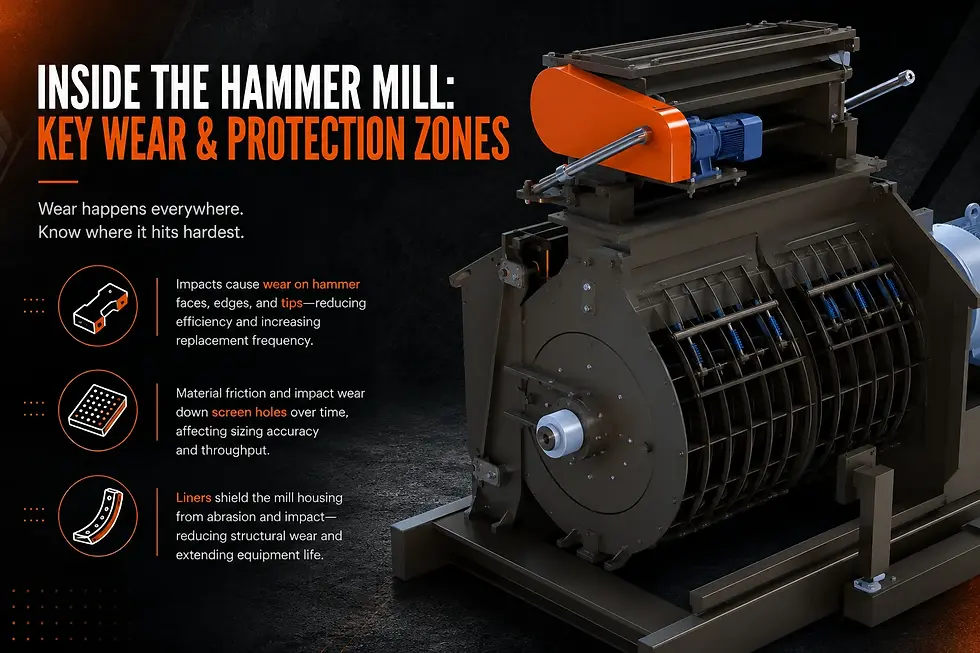
If all the parts inside a hammer mill experienced the same conditions,
maintenance planning would be a lot easier.
Unfortunately, that's not how a hammer mill (or really any industrial equipment) works.
Some components spend most of their lives supporting the grinding process in the background. Others take a direct beating from the material stream every minute they're operating. The difference between those two jobs has a lot to do with which parts wear out first.
Factors that influence wear rates

The material itself plays a major role.
Grinding soft agricultural products creates a very different wear environment than processing wood waste, biomass, minerals, or other abrasive materials. A hammer mill running one product today may show a completely different wear pattern after switching to another tomorrow.
Operating conditions matter just as much. Higher throughput rates, longer operating hours, and inconsistent feed characteristics all increase the workload placed on critical hammer mill wear parts.
That's why components such as hammers, screens, and wear liners are often treated as consumable replacement parts. They're designed to absorb the impact and abrasion generated during grinding so more expensive sections of the machine don't have to.
The goal isn't to prevent wear entirely. If a hammer mill is doing its job, wear is inevitable. The real challenge is knowing where it will occur first and recognizing the signs before performance starts heading in the wrong direction.
Hammer Mill Screens
In many hammer mill applications, screens are the fastest-wearing component in the machine.
Every particle that leaves the grinding chamber must pass through a screen opening. Unlike hammers, which primarily experience impact wear, screens are exposed to continuous abrasion from virtually every pound of material processed through the mill.
The finer the grind requirement, the faster screen wear often occurs. Small openings are subjected to constant particle contact, friction, and airflow. Over time, holes begin to enlarge, wire diameters become thinner, and cracks can develop around high-stress areas.
Common signs of screen wear:
✓ Enlarged screen openings
✓ Reduced particle size consistency
✓ Increased fines production
✓ Cracked or damaged screen sections
✓ Reduced grinding efficiency
✓ Higher energy consumption
Many operators first notice screen wear through changes in product quality rather than visible damage. Particle size distribution begins to drift, finished product becomes less consistent, and grinding performance gradually declines.
For this reason, screens are often considered a consumable component and are commonly the most frequently replaced wear part in a hammer mill.
Hammer Mill Hammers
If screens are often the first wear component operators replace, hammers usually aren't far behind.
They're the first parts to make direct contact with incoming material, and they repeat that job over and over again, often thousands of times per minute. Every impact removes a tiny amount of material from the hammer surface.
Most of the time, nobody notices. Then one day, throughput starts slipping, energy consumption creeps upward, or product consistency isn't quite what it used to be.
Wear tends to happen gradually.
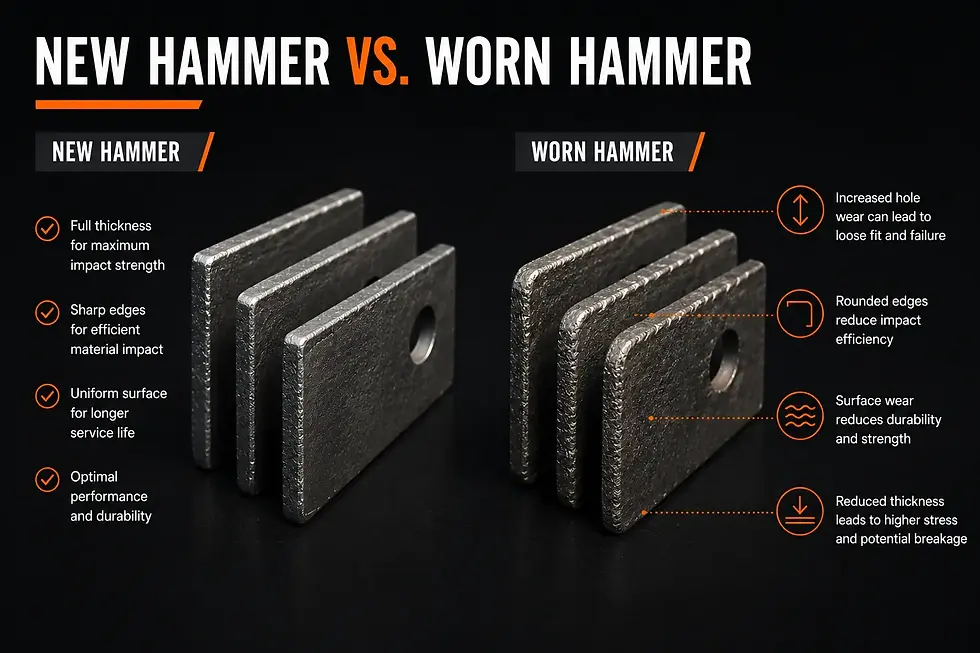
The sharp working edges begin to round off. The hammer profile changes. Material receives less efficient impacts, which can reduce grinding performance and force the mill to work harder to achieve the same result.
Common signs of hammer wear
✓ Rounded or worn hammer edges
✓ Reduced throughput
✓ Increased power consumption
✓ Inconsistent particle size
✓ More recirculation within the grinding chamber
One worn hammer isn't usually the problem.
The challenge begins when wear becomes uneven across the rotor assembly. Differences in hammer weight and profile can affect balance, increase vibration, and place additional stress on other components throughout the machine.
A useful way to think about hammer wear is to compare it to the tires on a truck. Tires don't usually wear out overnight, but as tread disappears, performance gradually changes. Handling becomes different. Stopping distances increase. Fuel efficiency can suffer.
Hammer wear follows a similar pattern.
The mill may continue operating, but grinding efficiency, product consistency, and overall performance often begin moving in the wrong direction long before complete replacement becomes necessary.
Regular inspection of hammer condition helps maintain grinding efficiency, improves product consistency, and prevents excessive wear from spreading to other replacement parts within the mill.
Hammer Mill Wear Liners

Wear liners have a simple job: protect the grinding chamber from abrasion and impact.
As material moves through the mill, particles don't just interact with hammers and screens. They also contact the internal housing surfaces. Wear liners act as a sacrificial barrier, absorbing that wear so the mill itself doesn't have to.
How wear liners wear
Wear Mechanism | Common Result |
Continuous abrasion | Material loss and thinning |
Material sliding and rubbing | Uneven wear patterns |
High-contact impact zones | Localized wear |
Unlike screens or hammers, liner wear is often easy to miss because it happens gradually. Over time, material is removed from the liner surface, reducing its ability to protect the housing behind it.
Common signs of wear liner deterioration
✓ Excessive liner thinning
✓ Uneven wear patterns
✓ Material loss in high-contact areas
✓ Exposed housing surfaces
The problem comes when worn liners stay in service too long. As liner thickness decreases, the grinding chamber becomes increasingly exposed to abrasion and impact. What could have been a straightforward liner replacement can eventually become a much larger repair.
Wear liners may not be the most frequently replaced hammer mill wear part, but they play an important role in protecting some of the most expensive components in the machine.
Hammer Mill Rods, Pins, and Bearings
These aren't usually the parts people think about first.
Ask someone about hammer mill wear parts and they'll probably mention hammers or screens. Rods, pins, and bearings tend to live in the background until something starts making noise, vibrating, or running hotter than it should.
Which is unfortunate, because these components play a critical role in keeping everything else working properly.
Hammer rods and pins support the hammers and allow them to move as intended during operation. Every impact generated inside the grinding chamber eventually transfers force through these components. Over thousands of operating hours, that constant loading can create wear, grooving, and fatigue.
Common issues to watch for
✓ Rod wear and grooving
✓ Pin elongation or deformation
✓ Excessive hammer movement
✓ Increased vibration
✓ Bearing temperature increases
✓ Unusual operating noise
One worn rod or pin may not seem like a major concern. The trouble is that wear rarely stays isolated.
As clearances increase, hammers may begin moving differently than intended. Rotor balance can be affected. Vibration levels can increase. Additional stress gets transferred to bearings and other rotating components.
Bearings deserve special attention here.
Technically, bearings aren't always considered traditional hammer mill wear parts, but they're often among the first components to signal that something else isn't right. Excessive vibration, contamination, misalignment, or uneven rotor loading can all shorten bearing life significantly.
Think of bearings as the machine's early warning system.
When bearing temperatures start climbing or vibration levels begin increasing, the bearing itself may not be the root cause. More often, it's telling you to look elsewhere before a small maintenance issue becomes a larger one.
Like most replacement parts, these components are far less expensive to replace during a planned shutdown than during an unexpected one.
Signs Your Hammer Mill Parts Need Replacement
Hammer mills are surprisingly good at giving warnings before something fails.
The problem is that those warnings don't usually arrive with flashing lights and dramatic alarms. More often, they show up as small changes that are easy to dismiss.
A little more vibration.
A little less throughput.
A motor working a little harder than it used to.
Each change on its own may not seem significant. Together, they often tell a different story.

Common warning signs to watch for
☐ Reduced throughput
☐ Increased power consumption
☐ Excessive vibration
☐ Unusual operating noise
☐ Inconsistent particle size
☐ Visible wear on hammers, screens, or liners
☐ Higher maintenance frequency
When production starts slipping
One of the first indicators of worn hammer mill parts is often a gradual decline in grinding performance.
Production targets that were once routine start taking longer to achieve. Feed rates may need adjustment. Operators begin making small changes to keep output where it needs to be. None of these symptoms automatically point to worn components, but they're often part of the story.
Changes in particle size consistency
Finished product quality can provide some of the clearest clues.
As hammers wear and screen openings gradually enlarge, particle size distribution can become less consistent. Depending on the application, that inconsistency may affect downstream processing, product quality, or overall system performance.
Sometimes the hammer mill is the source of the problem.
Sometimes it's simply the first place worth looking.
Vibration is rarely something to ignore
A hammer mill is never completely vibration-free, but noticeable increases deserve attention.
Uneven hammer wear, worn rods and pins, bearing issues, and rotor imbalance can all contribute to vibration levels that gradually increase over time. Left unchecked, those issues can create additional stress on other replacement parts throughout the machine.
The danger of gradual wear
The word that matters most here is gradual.
Most wear-related issues don't appear overnight. They develop slowly enough that operators become accustomed to them. What feels normal today may have looked very different six months ago.
Routine inspections help bridge that gap. They make it easier to spot wear trends before performance, reliability, or production output begins heading in the wrong direction.
Choosing Quality Replacement Parts
Replacing worn components is usually the easy part. Choosing the right replacement parts is where things get interesting.
Most operators have encountered it at least once. A replacement component arrives, gets installed, and technically fits. Then the mill starts behaving differently. Throughput drops. Vibration increases. Wear appears sooner than expected. Suddenly a simple maintenance task becomes a troubleshooting exercise.
Not all replacement parts are created equal
On the surface, many hammer mill parts can look nearly identical.
A hammer is a hammer. A screen is a screen.
Until it isn't.
Differences in material quality, manufacturing tolerances, heat treatment, and dimensional accuracy can have a significant impact on service life and overall mill performance.
What to look for when sourcing replacement parts
✓ Consistent material quality
✓ Accurate dimensions and fitment
✓ Proper metallurgy for the application
✓ Compatibility with existing equipment
✓ Reliable manufacturing standards
✓ Availability when maintenance is required
A replacement part spends its entire life operating in one of the harshest environments inside the plant. Small differences that seem insignificant during installation often become much more noticeable after thousands of operating hours.
Think beyond the purchase price
The least expensive part is not always the lowest-cost solution.
A component that wears prematurely may increase maintenance frequency, create additional downtime, or contribute to wear elsewhere in the system. In many cases, the labor required to replace a part costs far more than the part itself.
That's why experienced maintenance teams often evaluate replacement parts based on total operating cost rather than initial purchase price alone.
Building a smarter replacement strategy
The best time to think about replacement parts is usually before they're needed.
Keeping critical hammer mill wear parts on hand, monitoring wear trends, and planning replacements during scheduled maintenance windows can help reduce unexpected downtime and improve overall equipment reliability.
After all, nobody enjoys discovering a worn component at 2 a.m. on a Saturday.
Especially when the replacement part is still three states away.
Final Thoughts
Wear is part of the job.
Every hammer mill relies on components that absorb impact, abrasion, and constant material contact so the machine can continue doing what it was designed to do. Hammers, screens, wear liners, rods, pins, and bearings all play a role, and each will eventually reach the point where replacement becomes necessary.
The good news is that most wear-related problems don't appear without warning.
Regular inspections, attention to performance changes, and a proactive approach to replacement parts can help prevent small issues from becoming costly downtime events. A worn hammer or screen is usually a straightforward fix. Discovering it after it has affected throughput, product quality, or other components is where things become expensive.
A little attention today can save a lot of maintenance tomorrow.
Looking for hammer mill replacement parts?
Contact Midwest Custom Engineering to discuss your application or request a quote.
Explore our hammer mill parts.
Frequently Asked Questions
What are the most common hammer mill wear parts?
The most commonly replaced hammer mill wear parts include hammers, screens, wear liners, rods, pins, and bearings. These components experience the highest levels of impact, abrasion, or mechanical stress during normal operation.
How often should hammer mill parts be replaced?
Replacement intervals vary depending on the material being processed, operating hours, throughput, and maintenance practices. Rather than following a fixed schedule, many facilities monitor wear patterns through routine inspections and replace components based on condition.
How do I know if my hammer mill hammers need replacement?
Common signs of hammer wear include rounded edges, reduced throughput, increased power consumption, excessive vibration, and inconsistent particle size. Regular inspections can help identify wear before grinding performance is significantly affected.
Why do hammer mill screens wear out?
Screens are exposed to continuous particle contact as material passes through the grinding chamber. Over time, abrasion can enlarge screen openings, create cracks, or distort the screen, affecting product size consistency and overall mill performance.
Can worn hammer mill parts affect energy consumption?
Yes. Worn hammers, screens, and other components can reduce grinding efficiency, forcing the mill to work harder to achieve the same output. This often results in higher power consumption and increased operating costs.
Are aftermarket hammer mill replacement parts as good as OEM parts?
The quality of replacement parts depends on factors such as material selection, manufacturing accuracy, and application suitability. Well-manufactured replacement parts that meet dimensional and material requirements can provide reliable performance and service life.
Which hammer mill part typically wears out first?
In most hammer mill applications, screens are often the first component to require replacement. Because every particle must pass through the screen, it is subjected to continuous abrasion and material contact. The actual wear rate depends on the material being processed, screen size, throughput, and operating hours. Hammers, wear liners, rods, and bearings may also experience significant wear, but screens are commonly the highest-consumption wear item.
What causes hammer mill parts to wear faster?
Several factors can accelerate wear, including abrasive materials, high throughput rates, excessive operating hours, contamination, improper feed characteristics, and inadequate maintenance practices.


Comments