.png)
Maximizing Hammer Mill Efficiency: Essential Maintenance Tips

Updated: Apr 6
Table of Contents
When Grinding Problems Start Quietly
The Maintenance Reality Inside a Hammer Mill
7 Common Hammer Mill Maintenance Issues & How to Solve Them
Preventive Maintenance Checklist for Hammer Mills
Final Engineering Takeaway
Ready to Optimize Your Grinding Operation?
When Grinding Problems Start Quietly
Grinding issues often begin without fanfare. It rarely happens during a scheduled shutdown.
The grinding line is operational. Material feeds smoothly. Then, the operator notices something small. Motor amps are slightly higher than normal. Throughput drops a bit. The particle size coming off the screen appears inconsistent.
Nothing alarming. No alarms sound.
But seasoned operators understand the implications. Something inside the hammer mill isn’t functioning correctly.
Most grinding problems don’t stem from catastrophic equipment failure. They begin with minor maintenance issues that quietly accumulate over time. If left unaddressed, they lead to reduced throughput, increased energy consumption, and ultimately, unplanned downtime.
That’s why many plant managers turn to experienced engineering partners like Midwest Custom Engineering when grinding performance declines. They seek help not because of equipment failure, but because diagnosing the root cause requires a deep understanding of how grinding systems behave under real production conditions.
Understanding the most common hammer mill maintenance issues is the first step to ensuring your grinding system remains reliable.
The Maintenance Reality Inside a Hammer Mill
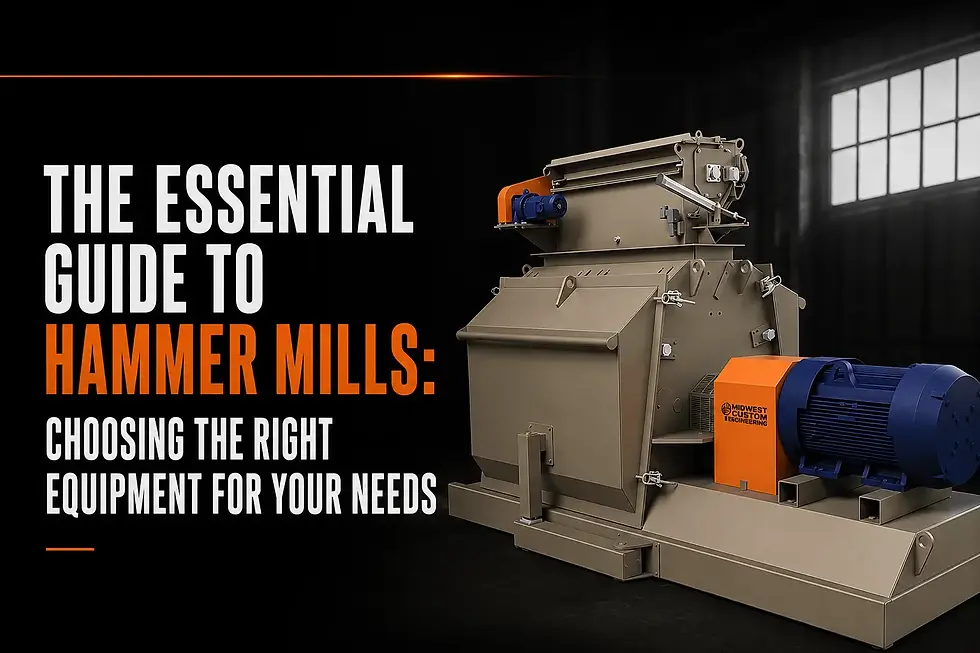
From the outside, a hammer mill appears straightforward. A rotor spins. Hammers strike material. Screens control the final particle size.
However, conditions inside the grinding chamber are severe.
High rotational speeds. Continuous impact forces. Abrasive material. Dust. Heat.
Every component inside the mill experiences gradual wear.
If maintenance practices aren’t consistent, the mill continues to run. But performance declines over time. Throughput drops. Power consumption rises. Operators may adjust feed rates just to stabilize the system.
Most plants don’t recognize the full impact until production targets are missed.
Let’s explore the seven maintenance issues that lead to most hammer mill performance problems.
Suggested Read:
7 Common Hammer Mill Maintenance Issues & How to Solve Them
Grinding Efficiency Starts With Smart Maintenance.
Maintaining a hammer mill isn't just about keeping it operational; it’s about safeguarding your throughput and your bottom line. I’ve witnessed how a well-executed maintenance routine can extend the life of a mill by decades. Conversely, neglect can transform a high-performance machine into a vibrating, overheating liability in mere months.
If you notice a decline in grind quality or a spike in energy costs, your mill is signaling a problem. Here are the seven most common hammer mill maintenance issues and engineered solutions to address them.
1. Worn or Damaged Hammers
Hammers endure the brunt of the grinding process. Over time, they wear down, round off, or become uneven. This wear leads to decreased grinding efficiency and increased energy consumption. You may also observe inconsistent particle size or reduced throughput.
How to solve it:
Regularly inspect hammer edges and thickness. Many hammer mills allow hammers to be reversed to utilize the opposite edge. Rotating them periodically helps extend their service life.
Once hammers become too thin or heavily worn, replace them as a full set to maintain rotor balance. Consistent hammer weight across the rotor is crucial for smooth operation.
2. Screen Blockage or Blinding
Screens determine the final particle size and are often a bottleneck in a hammer mill. Fine materials, moisture, or sticky ingredients can clog the screen openings.
When this occurs, the mill struggles to push material through, resulting in increased motor load, heat buildup, and reduced capacity.
How to solve it:
Regularly check screens for buildup or clogging. Clean them during scheduled maintenance intervals and replace them when holes become worn or distorted.
Also, ensure the screen size matches the material being processed. Sometimes, switching to a slightly larger screen or adjusting the feed rate can significantly enhance performance.
3. Rotor Imbalance and Vibration
A hammer mill rotor spinning at high speed must remain perfectly balanced. Even minor differences in hammer weight or uneven wear can cause vibration.
Operators may hear a thumping sound, notice excessive vibration in the mill housing, or observe unusual bearing wear. If left unchecked, this can damage bearings, couplings, and even the motor.
How to solve it:
Always replace hammers in matched sets and distribute them evenly across the rotor. After major maintenance, check rotor balance before restarting the mill.
If vibration persists, inspect the rotor assembly, hammer pins, and discs for wear or misalignment.
4. Excessive Bearing Wear
Bearings support the rotor and ensure smooth operation. However, dust, vibration, and high loads can shorten their lifespan if maintenance is inconsistent. Early warning signs include rising temperatures, grinding noises, or grease leakage.
How to solve it:
Adhere to a strict lubrication schedule using the manufacturer’s recommended grease type. Over-greasing can be just as detrimental as under-greasing, so apply the correct amount.
Regularly monitor bearing temperature and vibration. Catching problems early can prevent catastrophic failure.
5. Improper Feed Distribution
Hammer mills operate most efficiently when material enters the grinding chamber evenly. If feed enters in large clumps or accumulates on one side of the rotor, grinding becomes inconsistent.
This leads to uneven hammer wear, fluctuating motor load, and poor particle size control.
How to solve it:
Inspect the feeder system to ensure material spreads evenly across the hammer mill inlet. Vibratory feeders or well-designed inlets can help maintain consistent flow.
Operators should also avoid sudden feed surges that overload the grinding chamber.
6. Airflow and Dust Handling Problems
Proper airflow is crucial for hammer mills. Air helps move material through the grinding chamber and prevents heat buildup.
When airflow is restricted due to clogged filters, blocked ducts, or improperly sized fans, grinding efficiency drops. Heat increases, screens clog faster, and fine particles may accumulate inside the mill.
How to solve it:
Regularly inspect the dust collection system, ducting, and air assist components. Ensure airflow remains strong and unobstructed.
Proper air movement not only enhances grinding efficiency but also reduces dust hazards and keeps the system cleaner.
7. Loose or Worn Internal Components
Over time, internal components such as hammer pins, liners, and rotor plates can loosen or wear out. This may produce metallic noises, inconsistent grinding performance or internal damage.
Because hammer mills operate at high speeds, even small loose parts can quickly escalate into major failures.
How to solve it:
During scheduled shutdowns, conduct a full internal inspection. Check hammer pins, retaining rods, liners, and mounting hardware for wear or looseness.
Tightening or replacing worn components early can prevent costly downtime later.
Suggested Read:
Preventive Maintenance Checklist for Hammer Mills

How often should I rotate my hammers?
Inspect edges weekly. Rotate or flip hammers once the leading corner is rounded more than 1/4 of its original width to maintain grinding efficiency and prevent heat buildup.
Why is my mill vibrating excessively?
Excessive vibration usually indicates an imbalanced rotor. This occurs from uneven hammer wear or replacing single hammers instead of matched, balanced sets. Ensure opposite rows are within 15 grams of each other.
Can I over-grease the rotor bearings?
Yes. Over-greasing causes internal friction (churning) and seal failure. Follow the 50% Rule: only fill the bearing housing 1/3 to 1/2 full. Monitor for temperatures exceeding 40°C (104°F) above ambient. Hammer mills rarely fail without warning.
Final Engineering Takeaway
Hammer mills seldom fail without warning.
I’ve learned that a hammer mill's reliability hinges on the maintenance team behind it. From the precise balance of the rotor to the specific micron-level integrity of the screens, every component plays a role in your facility's safety and profitability.
Ignoring a vibrating bearing or a rounded hammer edge might save you ten minutes today, but it could cost you ten hours of downtime tomorrow. By implementing these seven solutions—rotating hammers early, managing grease levels, and ensuring a metered feed—you transition from reactive repairs to predictive performance.
Keep your edges sharp, vibrations low, and airflow consistent. If you stay ahead of the wear, your mill will deliver the consistent, high-quality grind your customers expect for years to come.
Maintain early. Grind efficiently. Produce consistently.
Ready to Optimize Your Grinding Operation?
Don't let preventable maintenance issues hinder your production. If your hammer mill shows signs of reduced efficiency, rising energy costs, or frequent minor breakdowns, it’s time for an expert assessment.
Contact Midwest Custom Engineering today for a comprehensive grinding system audit and maintenance plan tailored to your specific materials and throughput goals.


Comments