.png)
Choosing the Right Hammer Mill Feed Grinder: What to Know Before You Buy


Table of Contents
When feed production slows down, the entire operation feels it. Missed loads, inconsistent product quality and extra wear on downstream equipment all trace back to one thing: the wrong grinder for the job.
A hammer mill feed grinder plays a bigger role than most people realize. It's not just about breaking down grain, it's about protecting the flow of your entire feed system. When grinding is clean, efficient and reliable, everything from mixing to packaging runs better.
Choosing the right feed grinding system begins with understanding what your operation requires, not just today, but also in the future as production scales up. This guide breaks down what matters most when sizing, selecting and setting up a hammer mill that will keep pace with your goals.
Let’s start by understanding the first thing that defines your equipment needs: the material you're grinding.
Understand Your Feed Material
The first step in choosing the right hammer mill feed grinding system is knowing exactly what you’re putting through it. Feed materials aren’t all the same and treating them like they are leads to early wear, inconsistent particle sizes and a lot of downtime.
Grain type, hardness and moisture content all affect how a grinder performs. Corn, for example, is relatively easy to break down. Wheat and barley tend to be tougher and produce more fines if not properly handled. High-fiber materials like soybean hulls or hay require a different hammer arrangement to avoid clogging or uneven grind patterns.
Key material factors to consider:
Moisture Content: Wet or damp material can clog screens and reduce throughput. Materials above 15% moisture may need drying first.
Hardness: Harder grains wear out hammers and screens faster. You’ll need stronger, possibly heavier hammers to maintain performance over time.
Fiber Content: Fibrous materials resist clean breakage and require more aggressive hammer patterns or specialized screen designs.
The better you know your material, the better you can match the grinder to it and the more consistent your production will be.
Now that you know what your grinder needs to handle, the next step is dialing in the target particle size for your feed.
Define Your Target Particle Size
Getting the right particle size is more important than just appearance. In feed production, particle size directly impacts animal health, feed efficiency and how well the final product flows through the rest of your system.
A hammer mill feed grinder gives you control over particle size, but you need to set it up right from the beginning. Screen size, hammer configuration and rotor speed all work together to produce a consistent grind.
Key points to focus on:
Finer grinds are better for poultry and young livestock, improving digestion and feed conversion rates.
Coarser grinds work well for larger animals like cattle, where rougher material supports rumen health and reduces digestive issues.
Uniformity matters as much as size. Uneven particle sizes cause problems in mixing, lead to feed sorting by animals and create inconsistency in nutrient delivery.
How to control particle size:
Screens: Smaller holes produce finer grinds; larger holes leave a coarser product.
Hammer Patterns: More hammers or closer hammer spacing can improve fineness and consistency.
Rotor Speed: Higher speeds increase grinding intensity, but can also raise heat and wear.
Knowing the right target size for your feed material and setting your hammer mill system to hit that mark consistently saves time, reduces waste and protects the quality of your entire feed operation.
Next, we’ll look at matching grinder capacity to your production needs.
Match Hammer Mill Feed Grinder Capacity to Production Needs
Even the best hammer mill feed grinder will fall short if it’s undersized for the production demands it needs to meet. Grinder capacity isn’t just about horsepower; it’s about balancing throughput, consistency and runtime without overworking the system.
Before you pick a model, take a hard look at your production numbers.
Important factors to consider:
Daily Volume: How many tons of material need to move through the grinder during an average shift?
Peak Loads: Are there seasonal or operational spikes where capacity needs to stretch beyond the normal pace?
Continuous vs. Batch Operation: Some mills run around the clock, while others handle defined batches. Continuous operations need grinders designed for steady, high-volume performance with minimal cooling downtime.
Choosing a mill that operates close to its capacity without constantly maxing out extends its life, reduces maintenance and keeps performance consistent. If you expect growth in production over the next few years, it’s smarter to plan for that expansion now rather than outgrowing your system too soon.
A properly sized hammer mill feed grinder keeps the entire feed line moving efficiently, from initial grinding all the way through mixing, pelleting and bagging.
Now that you know how to size your grinder correctly, let's dive into the features that separate a solid hammer mill from one that struggles in real-world operations.
Key Features to Look for in a Hammer Mill Feed Grinder
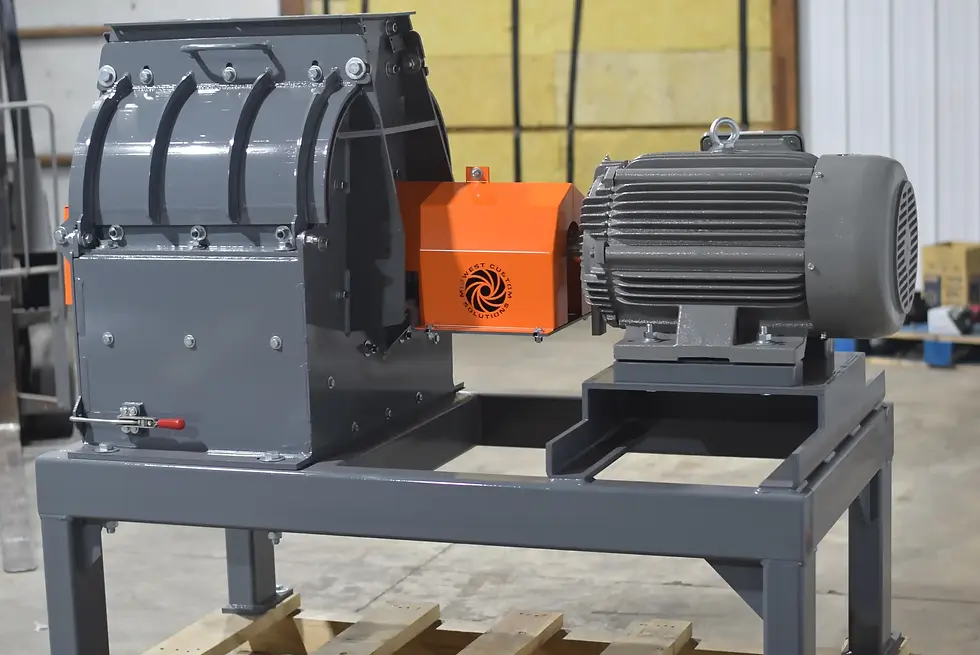
A hammer mill feed grinder goes beyond just a motor and a rotor. Small differences in design, construction and accessibility can add up to big differences in reliability, efficiency and maintenance costs over time.
When you're evaluating options, these are the features that deserve a closer look:
Rotor Strength and Balance
The rotor is the heart of the mill. A heavy-duty, dynamically balanced rotor ensures smoother operation, reduces vibration and extends the life of bearings and other critical components.
Hammer Configuration
Hammers come in different thicknesses, materials and patterns. Reversible hammers double their wear life. Hardened steel options resist heavy abrasion. Look for a setup that matches your material and expected run times.
Screen Design and Changeability
Quick-change screens save serious downtime. Good feed grinders make it easy to swap screens with minimal tools, allowing fast adjustments for different particle size requirements or material changes.
Access for Maintenance
Routine maintenance should be simple, not a full teardown. Look for features like:
Tool-free access doors
Bolt-on wear plates
Easy rotor removal or service
The easier it is to maintain, the more likely your team will stay ahead of problems before they turn into major repairs.
Build Material and Construction
The grinding chamber and frame should be built for the conditions they’ll face. For heavy-duty agricultural or light industrial environments, thick carbon steel often gets the job done. For high-wear or corrosive applications, stainless or abrasion-resistant steel can offer much longer service life.
Motor Sizing and Energy Efficiency
An oversized motor might sound like a plus, but matching motor size to expected load is smarter. Well-matched systems operate more efficiently, draw less power under load and experience fewer mechanical stresses over time.
Dust Control Options
Some feed mills need tight dust containment to meet health and safety regulations. Mills designed with built-in dust pickup fittings, sealed discharge points, or integrated ventilation options are easier to keep compliant.
Common Mistakes to Avoid When Buying a Hammer Mill Feed Grinder
Choosing a hammer mill feed grinder is a big investment for any feed operation. Avoiding a few common mistakes during the buying process can save you from major costs, production headaches and early equipment replacement.
Here’s what to watch out for:
Undersizing for Production Volume
It's easy to focus on current needs without thinking ahead. If you size your grinder too close to today’s volume, any growth in demand; seasonal spikes, new contracts, business expansion will push your system too hard. Always plan for a buffer between daily production and maximum grinder capacity.
Ignoring Maintenance Accessibility
Some hammer mills look good on paper but turn into maintenance nightmares once installed. Tight access doors, complicated screen changes, and poor component placement make routine service harder and increase downtime. Ease of maintenance isn’t a luxury, it’s a key part of uptime.
Overlooking Discharge Setup
Discharge design matters. If the mill’s output doesn't match the feed system, conveyor, or auger you're using, material buildup and flow restrictions will slow everything down. Check that your grinder’s discharge system integrates cleanly with the rest of your plant.
Focusing Only on Upfront Cost
A low sticker price can be tempting, but what matters is total lifecycle cost. Cheaper mills often mean lighter construction, more frequent part replacement and higher maintenance demands. A grinder that runs reliably, with less intervention usually costs far less over the life of the machine.
Final Thoughts: Getting It Right the First Time
A hammer mill feed grinding system isn’t just another piece of equipment. It’s a core part of your operation. When it’s matched properly to your material, your throughput needs and your long-term goals, it becomes a system you can count on shift after shift.
Beyond enhancing feed quality, the right grinder improves uptime, reduces maintenance costs and keeps production moving the way it should. Getting it right the first time saves time, saves money and protects your operation from costly headaches down the line.
If you’re looking for real-world advice on selecting the right hammer mill, Midwest Custom Engineering, Inc. is here to help. From material testing to system design, we work with you to build solutions that fit and that last.
Ready to build the perfect hammer mill feed grinder designed for your exact requirements?
Recommended Reads
Enjoyed reading this? You may also find these recommended articles worth your time.


Comments