
Retrofit or Replace? How to Know What Your Bliss Hammer Mill Really Needs
Every hammer mill eventually needs work done on it. That much is inevitable.
The harder question is what kind of work.
Sometimes it's obvious, a hammer is worn down, a screen is cracked, a liner has gone paper-thin. Swap the part, get back to running.
Other times it's not that simple. The same part keeps failing. Throughput keeps drifting. And no matter how many new components go in, something about the mill just isn't keeping up with the job it's being asked to do anymore.
That's usually the point where the real question shows up: do you need a part, a retrofit, or something bigger?
The Question We Hear Most Often
"Do I need a new part, or do I need to change how this mill is built?"
It's one of the questions Midwest Custom Engineering hears regularly from plants running older hammer mills, and the honest answer is: it depends on whether you're fighting a single worn part or a pattern.
A part replacement restores a component to its original condition: same fit, same function, back to running.
A retrofit changes the equipment itself, the feed system, the wear protection, the rotor and hammer configuration, so the mill is reconfigured to match the job it's actually doing today, not just the job it was built for years ago.
Four Ways to Fix a Hammer Mill Problem
Once something needs to change, there are really only four paths forward. Matching the right one to the right problem is most of the battle:
✓ Replace the part. The mill itself is sound; one component has simply reached the end of its life.
✓ Rebuild the mill. Several wear components need attention at once, but the core equipment is still fundamentally right for the job.
✓ Retrofit the mill. The equipment is sound, but the job has changed — different material, higher throughput, tighter particle-size targets — and the mill needs to be reconfigured to match it.
✓ Replace the mill. The housing, drive, or frame has reached the end of its service life, or the mill has been outgrown entirely.
The rest of this article walks through how to tell which one you're actually looking at.

Signs a Hammer Mill Retrofit Kit Is Worth Evaluating
A retrofit isn't the first thing to reach for, it's what's worth considering once a pattern shows up. On its own, almost any one of the signs below could simply mean a part is due. It's when several start showing up together, or alongside a real change in your process, that a retrofit evaluation earns a closer look:
✓ You're replacing the same component on a shorter cycle than you used to
✓ Throughput has drifted down even though maintenance is current
✓ Particle size is inconsistent across a production run
✓ Downtime for changeovers or screen swaps is cutting into run time
✓ You've added a new material or changed a recipe and the Bliss Eliminator Hammer Mill wasn't originally sized for it
Sign | What It Could Mean |
You're replacing the same component on a shorter cycle than you used to | The part isn't the problem — something about how the mill is configured is accelerating wear |
Throughput has drifted down even though maintenance is current | Routine maintenance isn't the fix — the mill's configuration may no longer match the job |
Particle size is inconsistent across a production run | Points to a rotor, hammer, or screen configuration issue rather than a single worn part |
Downtime for changeovers or screen swaps is cutting into run time | A sign the mill's setup isn't matched to how often you're actually changing products |
You've added a new material or changed a recipe and the mill wasn't originally sized for it | The mill is being asked to do a job it wasn't originally configured for |
Any one of these can justify taking a closer look. When several appear together, or when the operating conditions have changed since the mill was installed, the case for a retrofit evaluation becomes much stronger. That's exactly what a retrofit kit is built to solve:
✓ Feed system: can help address inconsistent feeding, surging, or material distribution
✓ Wear protection: can address areas experiencing accelerated wear and help improve component life
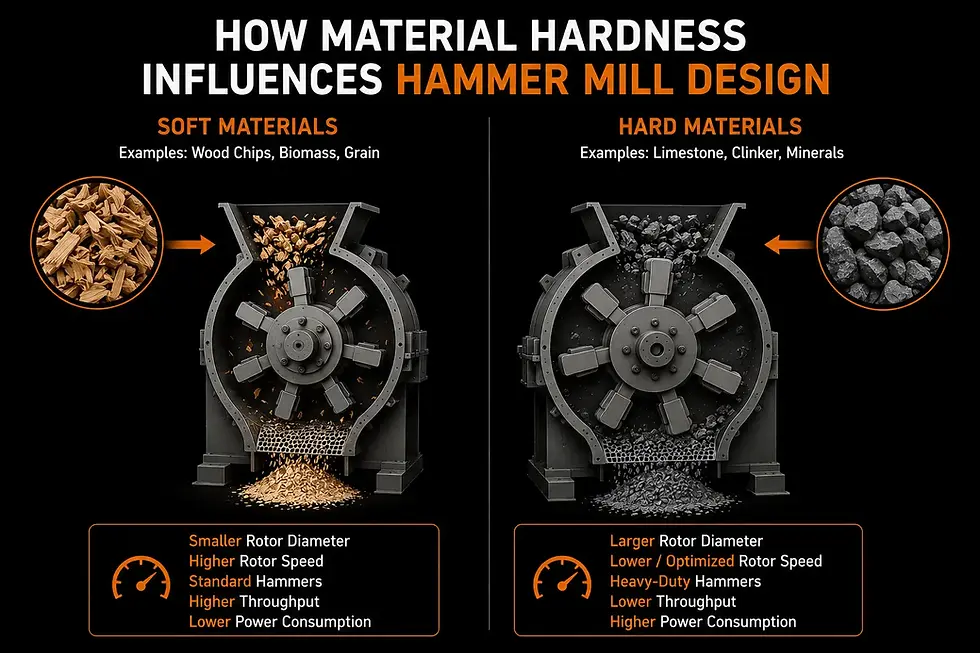
✓ Rotor and hammer configuration: can be evaluated when material characteristics, production requirements, or particle-size targets have changed
What Midwest Custom Engineering Evaluates Before Recommending a Retrofit
✓ Your mill model
✓ Current throughput and particle-size targets
✓ What's failing, and how often
✓ What's changed in your process since the mill was installed
A retrofit that isn't matched to your actual operating conditions is just an expensive part swap.
This evaluation step is where the real value gets decided, not in the parts
catalog.
The mill may not have become the problem. The job it's being asked to do may have changed.
When a mill went in, it was typically sized around a specific material, a target throughput, a particle-size range, and a production schedule. Today's numbers might look different, different material, higher throughput, tighter particle-size requirements, more operating hours, or different feed characteristics. The mill can be running exactly as it was designed to and still fall short, simply because the job changed and the equipment didn't.
This is where experience with legacy equipment matters. A hammer mill doesn't necessarily need to be replaced simply because it's older. And it doesn't necessarily need a retrofit simply because it's experiencing wear. The right answer depends on the equipment, the operating conditions, and what the plant needs that mill to do today. That's the evaluation Midwest Custom Engineering brings to the conversation.
In some applications, the right retrofit can do more than restore performance, it can create additional capacity. Depending on the mill, material, and operating conditions, MCE retrofit solutions can be evaluated for throughput improvements of up to 20%. Actual results depend on the equipment and application.
Don't Look at the Retrofit Cost in Isolation
A retrofit kit's price tag is only part of the equation. The real comparison is against everything a mill problem is already costing you, whether or not a retrofit ever happens:
✓ Recurring parts costs
✓ Downtime for repairs and swaps
✓ Lost production during that downtime
✓ Labor hours spent on repeat fixes
✓ Changeover time between runs
✓ Energy consumption from an inefficient setup
✓ Whether throughput requirements are being met
✓ Remaining life left in the rest of the equipment
✓ Parts availability going forward
Weighed against all of that, a retrofit's cost often looks very different than it does as a standalone number.
When a Full Replacement Makes More Sense Than a Retrofit
Not every mill problem is a retrofit problem. A retrofit kit extends the life and performance of a mill that's fundamentally sound. It's not a fix for a mill that's reached the end of the road.
If the housing, drive, or frame has reached the end of its service life, or your volume has grown well past what the current mill size can support, Midwest Custom Engineering will tell you that plainly, rather than sell a kit that only delays the real decision.
Parts availability is also part of that conversation, especially on legacy Bliss equipment. An older mill can come with difficult-to-source components, obsolete configurations, rising maintenance costs, and declining manufacturer support. When that's the case, the question isn't simply repair versus retrofit. It becomes a choice between reverse-engineered replacement parts, a full rebuild, a retrofit kit, or a full equipment upgrade, and matching the right one to the right mill is exactly what MCE's broader capabilities are built for.
Final Thoughts
The goal isn't to sell you a retrofit. It's to get the right answer for the mill.
Sometimes that's a replacement part. Sometimes it's a rebuild. Sometimes it's a retrofit. And sometimes the honest answer is that the equipment needs to be replaced.
The important thing is understanding why the mill isn't meeting the job anymore before spending money on the next solution.
The upside is that the diagnosis itself isn't complicated. Track what's failing, how often, and what's changed since the mill went in, and the answer between retrofit and replace tends to become pretty clear on its own.
You can also see more of how Midwest Custom Engineering approaches builds and upgrades like this on the company's YouTube channel, where the team covers what's actually happening on the plant floor.
Frequently Asked Questions
What's the difference between a hammer mill part replacement and a retrofit kit?
A part replacement fixes a specific worn component — a hammer, screen, or liner that's reached the end of its life. A retrofit kit addresses why that part keeps wearing out or underperforming in the first place, whether that's a feeder, a wear liner package, or a rotor and hammer configuration mismatched to your current process.
How do I know if my hammer mill needs a retrofit instead of a repair?
Watch for patterns rather than single incidents: shortened replacement cycles, declining throughput despite current maintenance, inconsistent particle size, or a process or material change since the mill was installed. Any one of these can justify a closer look, and the case gets stronger the more that appear together or the more operating conditions have changed.
What does Midwest Custom Engineering look at before recommending a retrofit kit?
The mill model, current throughput and particle-size targets, what's failing and how often, and what's changed in the process since installation. The goal is to match the retrofit to actual operating conditions, not sell a generic kit.
When does it make more sense to replace a hammer mill instead of retrofitting it?
When the housing, drive, or frame has reached the end of its service life, or when production volume has outgrown what the current mill size can support. A retrofit can extend a sound mill's life, but it can't fix a structural or capacity limit — only a new mill can.
Can a retrofit kit increase throughput on an existing hammer mill?
Yes, in the right applications. When the right retrofit addresses what's actually limiting a mill's performance — feed consistency, wear protection, or rotor and hammer configuration — MCE evaluates it for measurable throughput gains, in some cases up to 20%. Actual results depend on the mill and application.
Not Sure What Your Hammer Mill Needs?
Give Midwest Custom Engineering the details on your mill, and we'll help you determine whether the right answer is a replacement part, a rebuild, a retrofit, or a larger equipment solution. Here's what's useful to have ready:
✓ Your mill model
✓ What material you're processing
✓ What's failing, and how often
✓ Your throughput goal
Curious how material hardness affects rotor and hammer sizing?
Want to catch wear issues before they turn into a retrofit conversation?
Also running rotary dryers in your operation?
Want to see how Midwest Custom Engineering engineers its retrofit kits?
Need a part now? Call the Hammer Mill Parts Hotline at +1-772-300-9035. For everything else, from retrofit evaluations to full rebuilds, reach us at +1-772-200-4060.


Comments